

Technical debt rarely appears as a line item in a budget. Its costs show up elsewhere: a feature that takes twice as long as expected, a team that relies on spreadsheets to bridge gaps between systems, a recurring defect that disrupts customers, or a strategic initiative that keeps getting delayed because the underlying technology cannot support it.
By the time leaders call it technical debt, the business may already be paying for it through slower delivery, higher operating effort, greater risk, and missed opportunity.
That is why technical debt cannot remain an engineering-only conversation. Leaders do not need to understand every dependency, framework, or architectural decision. They do need enough visibility to recognize when software is constraining the business and to decide which constraints deserve investment.
What technical debt actually means
Technical debt describes the future cost created when a team makes a technology decision that is faster, simpler, or more practical in the short term but requires additional work later. The term can refer to rushed code, outdated architecture, weak documentation, fragile integrations, deferred upgrades, limited testing, or design choices that no longer fit the business.
Not all technical debt reflects poor judgment. A startup may intentionally choose a faster solution to test demand. A team may accept a temporary workaround to meet a regulatory deadline or respond to an urgent customer need. Those decisions can be reasonable when the tradeoff is visible, the consequences are understood, and the organization has a plan to revisit the choice.
Debt becomes dangerous when it accumulates without ownership. The original context disappears, temporary solutions become permanent, and each new change must work around decisions the business no longer remembers making.
Older software is not automatically technical debt
Age alone does not determine whether a system has become a liability. Older software may continue to perform reliably, support current workflows, meet security requirements, and remain cost-effective to maintain. Replacing it simply because newer technology exists may create more disruption than value.
The more useful question is whether the system still supports what the business needs to do next. A system becomes a business concern when it limits growth, makes change unnecessarily expensive, increases operational risk, or prevents the organization from serving customers effectively.
Eight business signals of technical debt
Technical debt often becomes visible through patterns leaders already recognize. The following signals do not automatically prove that a system needs replacement, but they indicate that the underlying constraints deserve investigation.
New features consistently take longer than expected. When seemingly straightforward requests require extensive regression testing, specialized knowledge, or changes across tightly connected components, the existing architecture may be increasing the cost of every improvement.
Teams depend on manual workarounds. Spreadsheets, duplicate data entry, copy-and-paste processes, and manual reconciliations often indicate that systems no longer support the full workflow. The software may still function, but employees are absorbing the gaps.
Recurring defects interrupt customers or employees. Repeated performance problems, failed transactions, inconsistent data, or unreliable workflows consume support capacity and weaken trust. Fixing the same class of problem repeatedly may cost more than addressing its source.
Integrations are fragile or poorly understood. An integration that depends on one employee’s knowledge, lacks documentation, or fails whenever another system changes creates operational risk. The business may avoid improvements because nobody feels confident predicting the consequences.
Strategic initiatives keep waiting for the underlying systems. Security improvements, compliance work, cloud migration, analytics, and AI initiatives often expose weaknesses that daily operations can hide. If every new priority first requires extensive foundational work, the foundation has become part of the strategy.
Maintenance costs rise without creating new value. A growing share of the technology budget may go toward keeping existing systems stable rather than improving customer experience, increasing capacity, or enabling new revenue. The problem is not maintenance itself; it is maintenance that crowds out progress.
The organization avoids changing critical systems. Fear is an important signal. When leaders hear that a system is too risky to touch, too dependent on one vendor, or too difficult to test, the business has lost useful control over an important asset.
Technical work is repeatedly postponed because its business effect is unclear. Engineering teams may understand the risk but struggle to explain it in operational or financial terms. Without a clear connection to business outcomes, foundational work competes poorly against visible features and urgent requests.
How technical debt affects the business
The cost of technical debt extends beyond development. It changes what the company can promise, how quickly teams can respond, and how confidently leaders can invest.
- Delivery slows because each change requires more analysis, testing, coordination, or rework.
- Operating effort increases as employees compensate for missing or unreliable workflows.
- Customer experience suffers when defects, delays, or inconsistent information reach the people using the product.
- Risk grows when security updates, compliance requirements, backups, monitoring, or vendor dependencies remain unresolved.
- Opportunity narrows when the organization cannot integrate a new partner, launch a product, use its data, or adopt AI without first repairing the foundation.
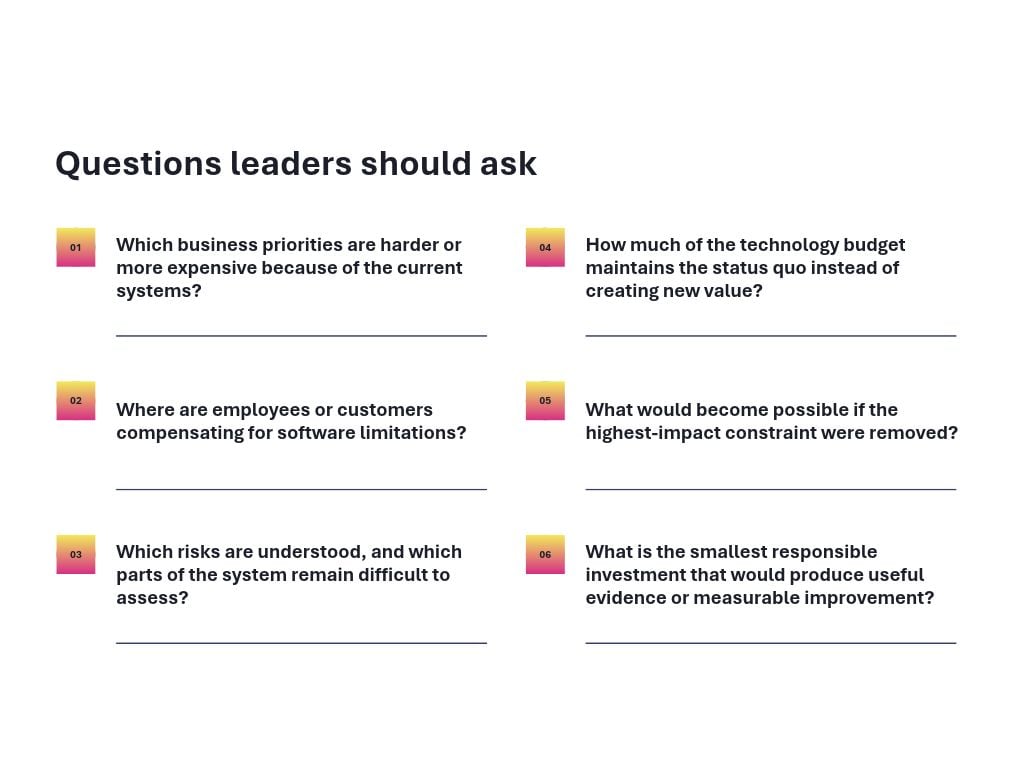
- Which business priorities are harder or more expensive because of the current systems?
- Where are employees or customers compensating for software limitations?
- Which risks are understood, and which parts of the system remain difficult to assess?
- How much of the technology budget maintains the status quo instead of creating new value?
- What would become possible if the highest-impact constraint were removed?
- What is the smallest responsible investment that would produce useful evidence or measurable improvement?
These effects give leadership and technical teams a shared language. Instead of debating whether the code is elegant or the architecture is modern, the organization can discuss the business capacity the software enables or prevents.
A practical framework for prioritizing technical debt
The goal is not to eliminate every imperfect decision. Most businesses will always carry some technical debt. The goal is to understand it well enough to manage the areas that create the greatest limitation or risk.
1. Identify the business process or outcome being constrained. Begin with the work the organization needs to perform. Name the affected customer journey, internal workflow, revenue opportunity, compliance obligation, or strategic priority.
2. Describe the current impact. Translate the technical condition into consequences leaders can evaluate. Consider operating hours, support volume, delivery delays, infrastructure spending, customer friction, revenue exposure, and risk.
3. Determine whether the debt is stable, worsening, or blocking a priority. A known limitation that remains contained may be manageable. A constraint that grows with every release, depends on disappearing expertise, or prevents a planned initiative requires more urgent attention.
4. Compare the available responses. The choices are broader than ignoring the problem or rewriting everything. The team may improve one component, strengthen testing and documentation, replace an integration, modernize incrementally, move part of the system, adopt an existing platform, or replace the application.
5. Prioritize the areas with the greatest business leverage. Focus first on constraints whose improvement will reduce risk, restore delivery capacity, lower operating effort, or unlock an important opportunity. Technical severity matters, but business effect should guide sequence.
6. Define evidence of progress. Choose measures that match the reason for the investment. Useful indicators may include release frequency, lead time for changes, defect volume, uptime, support requests, manual hours, infrastructure cost, security findings, or time required to onboard a customer.
Modernization does not have to mean rewriting everything
A full rewrite can feel decisive, but it also introduces cost, operational disruption, migration risk, and the possibility of rebuilding behavior that nobody documented. In many cases, the stronger strategy is to improve the highest-impact constraints in a deliberate sequence.
That might mean stabilizing a fragile integration before replacing a larger application, separating one high-change function from a monolith, improving observability before changing architecture, or retiring a manual workflow that creates disproportionate support work. Incremental modernization can produce meaningful business value while preserving the parts of the system that still work.
The right approach depends on the business objective, the condition of the system, the quality of available documentation and data, the organization’s tolerance for disruption, and the opportunity cost of continued delay.
Technical debt deserves a business decision
Technical debt becomes expensive when it remains invisible. Once leaders can connect system constraints to delivery, operations, customers, risk, and opportunity, the organization can make a deliberate choice: continue maintaining the debt, reduce it incrementally, modernize a critical area, or replace a system that no longer supports the business.
That decision should not begin with a preferred technology. It should begin with the business outcome the organization needs and the evidence showing what currently stands in the way.