

Choosing a software development partner can feel like making a high-stakes decision with incomplete information.
You may be comparing proposals that define the work differently, estimates that do not measure the same things, and teams that all promise speed, quality, and expertise. Yet the qualities that determine whether a partnership will work are rarely visible in a sales deck. They emerge in how a team asks questions, explains uncertainty, makes tradeoffs, and responds when the plan changes.
The decision matters because software rarely stays contained to a single project. It becomes part of how your business serves customers, moves information, supports employees, meets obligations, and grows. When the relationship behind that software is unreliable, the cost shows up in more than missed deadlines: leaders lose visibility, teams spend time chasing answers, avoidable rework grows, and important business decisions get delayed.
The goal is not to find a partner who promises certainty. Software development involves discovery, changing information, and tradeoffs. The goal is to find a partner who makes uncertainty visible, manageable, and shared. The most useful question is not simply, “Can this team build what we described?” It is, “Can we make good decisions together when the facts change?”
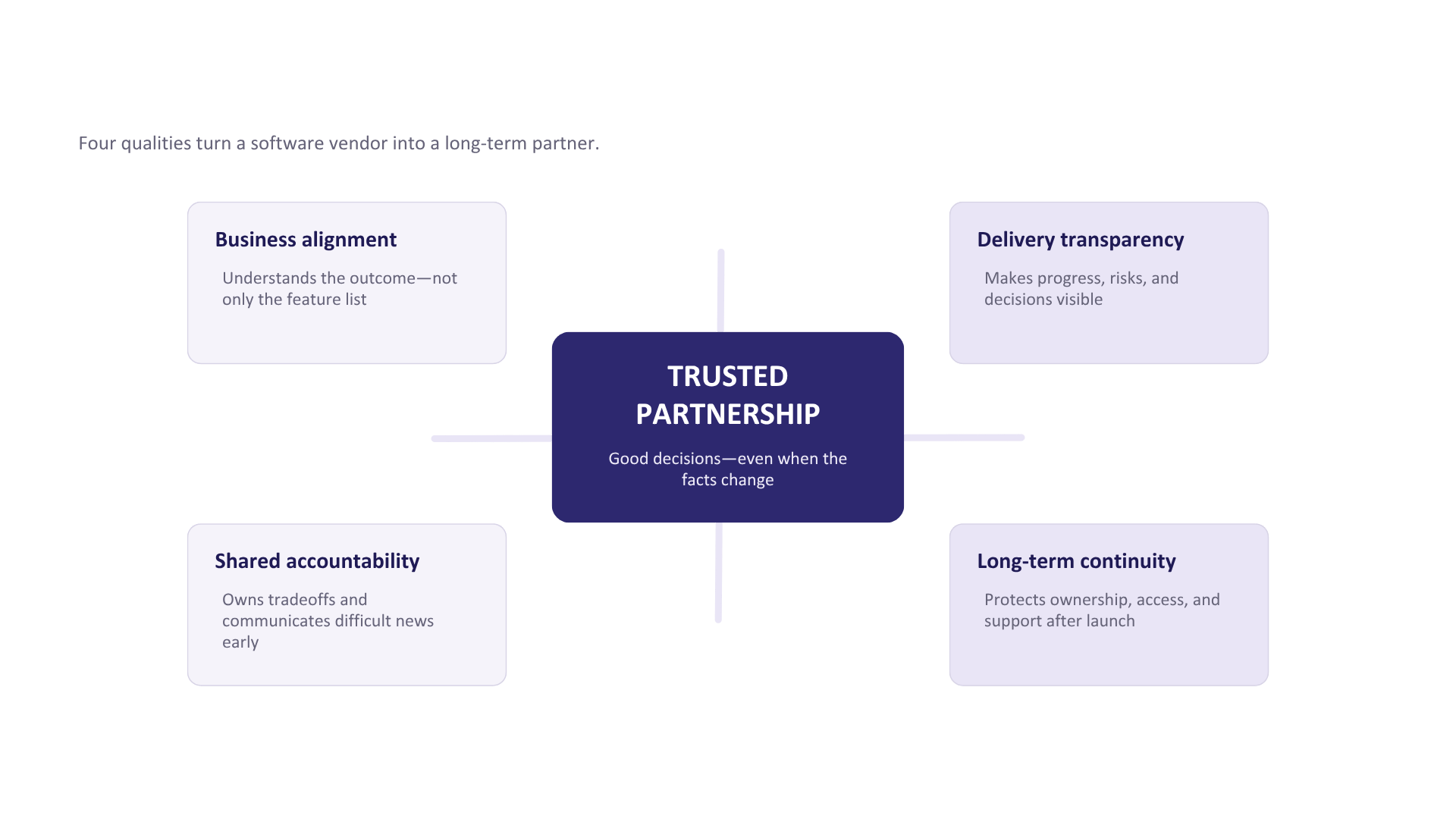
1. Start with how they think about the business
A capable team can build what you ask for. A trusted partner will first help determine whether what you are asking for is the right investment.
Before recommending features or technology, the team should be curious about the users, workflows, business model, constraints, risks, and outcomes behind the request. They should be willing to challenge assumptions, separate needs from preferences, and identify a smaller or more valuable path when one exists. That is not resistance; it is evidence that they are protecting the business outcome rather than simply maximizing the scope.
Listen carefully to the questions asked during early conversations. Are they collecting a feature list, or building an understanding of how the product will create value inside the business? Useful questions include:
- What business problem are we solving, and who experiences it most directly?
- What measurable change would tell us the investment is working?
- Which assumptions should be tested before the largest investments are made?
- What operational, regulatory, security, data, or integration constraints could shape the solution?
- What belongs in the first release, and what should deliberately wait until we learn more?
2. Ask what the estimate actually includes
Price matters. But the lowest number is not necessarily the lowest-cost path, especially when proposals do not include the same work or assign risk in the same way.
One estimate may include discovery, design, project leadership, quality assurance, deployment, documentation, security review, and post-launch stabilization. Another may cover implementation alone. The second can appear less expensive until the omitted work becomes unavoidable—or until the client discovers that critical responsibilities were never assigned.
Ask each potential partner to walk through the estimate in plain language:
- Which assumptions are built into the estimate, and how were they formed?
- What is included, what is excluded, and what is still unknown?
- How are discovery, design, QA, deployment, documentation, and project leadership accounted for?
- Which dependencies or decisions could reasonably change the scope, cost, or timeline?
- How will changes be evaluated, communicated, approved, and documented?
- What will the client need to provide, decide, or review to keep the work moving?
A trustworthy partner should be able to show where a number comes from and explain the confidence behind it. Precision without sufficient discovery is not the same as certainty. Often, the more responsible answer is a range, a set of assumptions, and a plan for reducing the unknowns before making a larger commitment.
3. Look for a delivery process that creates visibility
Trust should not require blind faith. It should be reinforced by a delivery process that lets you see progress, understand decisions, and raise concerns while there is still time to respond. Visibility is not the same as more meetings or longer status reports; it means the right information reaches the right people in time to make a decision.
Before signing an agreement, ask what you will be able to see and how often you will see it:
- Current priorities and the work planned next
- Progress against milestones, budget, and expected outcomes
- Risks, blockers, dependencies, and unresolved decisions
- Working software and regular opportunities to provide feedback
- Quality signals, testing status, and release readiness
- Team responsibilities, decision owners, and points of contact
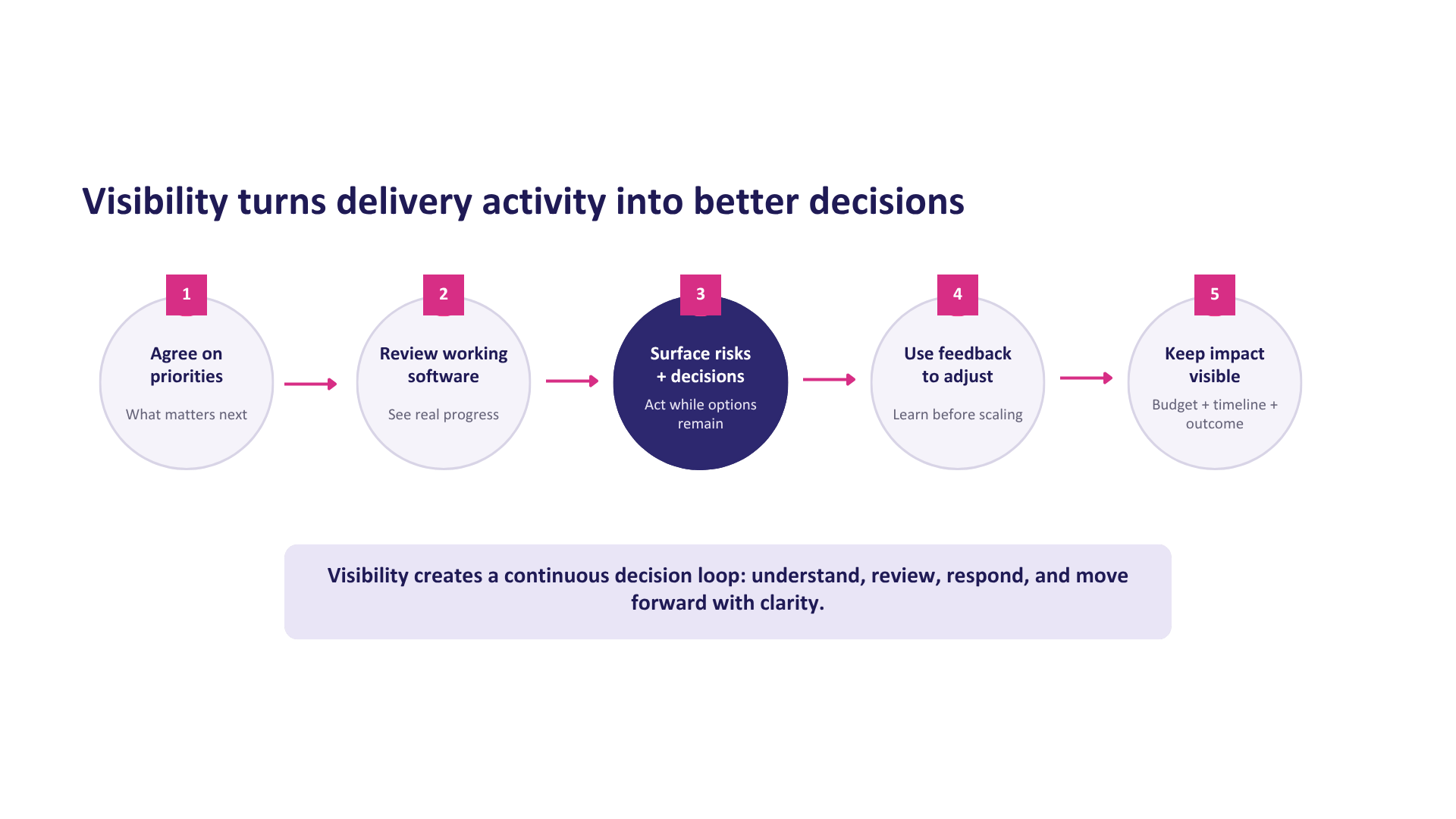
Be cautious when visibility depends on asking the right person for an update or when status is expressed only as a percentage complete. The strongest answer is not a promise that nothing will go wrong. It is a clear explanation of how the team will recognize problems, surface them early, present options, and document the decision that follows.
4. Evaluate how the team handles difficult conversations
Every meaningful software project includes tradeoffs. A deadline may conflict with scope. An integration may be less reliable than expected. User feedback may challenge an early assumption. A security or compliance requirement may change the design. Even a well-run project can encounter surprises; the difference is how quickly and honestly the team responds.
The quality of the partnership becomes most visible in these moments—not when everything is going according to plan.
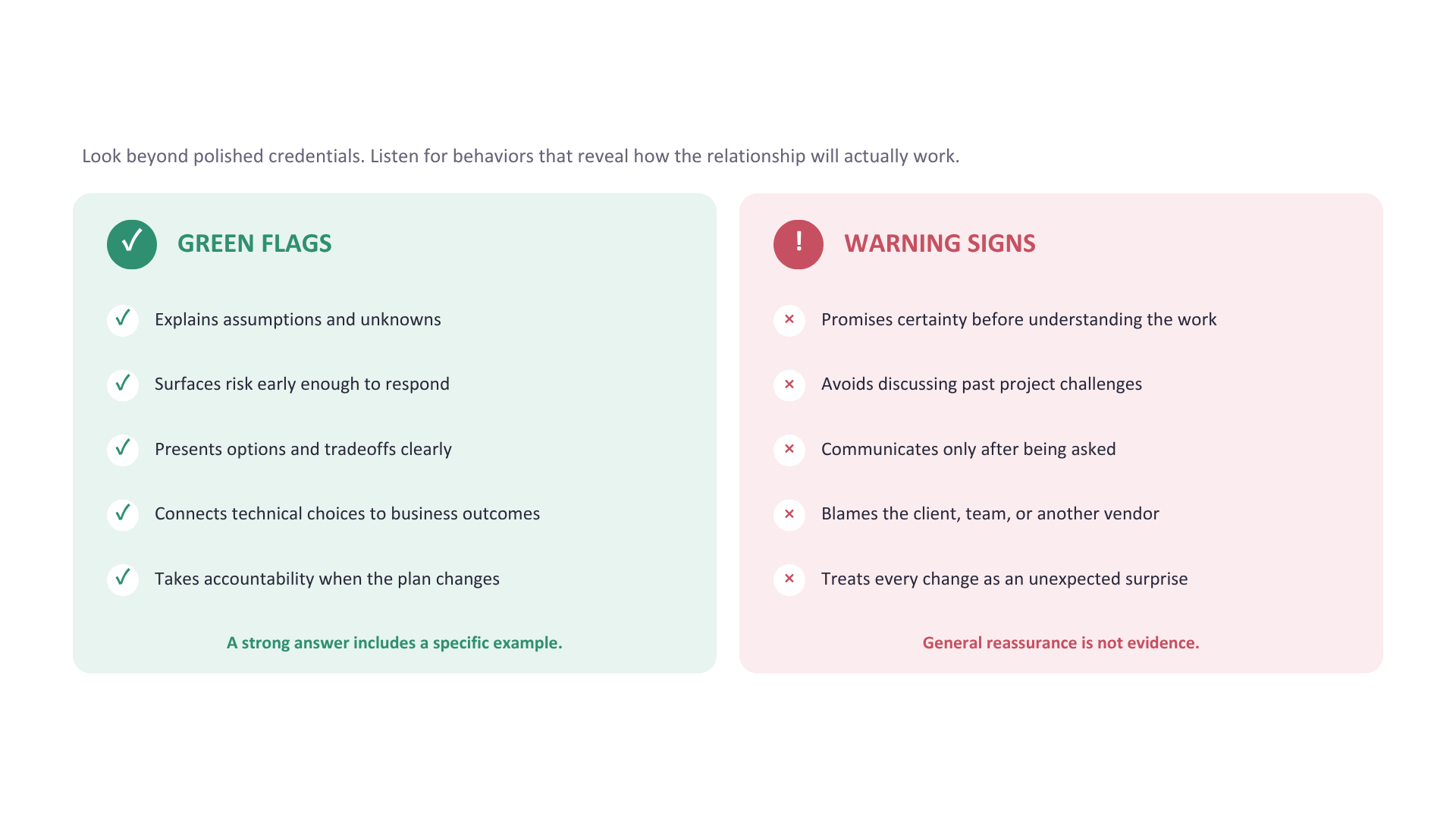
Ask prospective partners to describe a project that changed materially after work began. What did they learn? When did the client hear about it? How did they explain the impact? What options did they present? What did the team change afterward?
Specific, thoughtful answers are more useful than claims of a perfect record. Listen for ownership rather than blame, evidence rather than reassurance, and a willingness to distinguish an uncomfortable truth from a convenient answer. A partner should be able to disagree with you respectfully and still remain accountable for helping the team move forward.
5. Understand who will actually do the work
The people leading the sales conversation may not be the people guiding delivery. Before the engagement begins, understand the real team structure, how decisions flow through it, and where accountability sits.
- Who owns the client relationship and day-to-day communication?
- Who is accountable for architecture and major technical decisions?
- How are development, design, product thinking, and QA organized?
- Where is the team located, and how will time-zone coverage and handoffs work?
- How are team members selected, onboarded, supported, and evaluated?
- What happens if a key person becomes unavailable or the team needs to scale?
6. Ask how the partner uses AI—and where they do not
Most development teams now use AI in some form. The more useful question is not whether a potential partner uses it, but how. AI can help an experienced team move faster by supporting tasks such as research, prototyping, documentation, testing, code review, and repetitive implementation work. Used thoughtfully, it can create more room for the team to focus on the decisions that require deeper business and technical judgment.
But the ability to generate code quickly is not the same as the ability to build reliable software. AI-generated work can be incomplete, insecure, poorly suited to the existing architecture, or simply wrong. A development partner should approach those outputs with healthy skepticism, applying years of experience to verify the work, question its assumptions, and decide whether it belongs in the product at all.
Ask prospective partners to explain where AI enters their development process and what remains firmly under human control:
- Which tasks are supported by AI, and which decisions require experienced human judgment?
- How is AI-generated code, documentation, or test coverage reviewed and verified before it is accepted?
- Who remains accountable for architecture, security, quality, and product decisions?
- What safeguards prevent sensitive client information, proprietary code, or regulated data from being exposed to unapproved tools?
- How does the team measure whether AI is improving delivery rather than merely increasing output?
Be cautious of partners who present AI primarily as a way to remove people from the process or promise dramatic speed and cost reductions without explaining their review practices. The strongest teams use AI to augment critical thinking—not replace it. They remain accountable for every decision and every piece of work they deliver, regardless of how it was produced.
7. Protect ownership, access, and continuity
Your ability to operate the product should not depend on the continued goodwill—or availability—of a single vendor or individual.
Clarify who owns the source code and work product, where code will be stored, how access is managed, and what documentation will be maintained. Your organization should have appropriate visibility into repositories, environments, credentials, third-party accounts, deployment processes, and critical technical decisions. Ownership on paper is not enough if the product cannot be understood, accessed, or operated without the original team.
Also ask what a transition would look like if the relationship ended. Who would prepare the handoff? What documentation and access would be provided? How would open work and known risks be communicated? A good partner should be prepared to make the product supportable—not create dependence through obscurity.
8. Think beyond the first launch
Launch is a milestone, not the end of the software lifecycle. Products require monitoring, security updates, performance improvements, user support, new features, and adaptation as the business changes. Decisions made during the build will either make that future work easier or quietly make it more expensive.
Before choosing a partner, understand what happens after the initial release:
- Is there a defined stabilization or warranty period, and what does it cover?
- How are defects distinguished from enhancements or new requests?
- What ongoing support, maintenance, or managed-service options are available?
- How are performance, security, backups, availability, and third-party dependencies monitored?
- Can the team support the product as usage, complexity, and business priorities change?
A partner who expects to support the full lifecycle will make different decisions during the build. They are more likely to prioritize maintainability, documentation, observability, and knowledge transfer because they expect the consequences of today’s shortcuts to become tomorrow’s work.
9. Use references to test the relationship, not just the result
When speaking with references, it is natural to ask whether a project launched successfully. Go further. The most revealing questions are about what happened when priorities changed, feedback was difficult, or an unexpected problem emerged.
- Did the partner communicate bad news early enough for the client to act?
- Were estimates, invoices, status updates, and tradeoffs understandable?
- Did the team consistently connect technical decisions to business needs?
- Did the client feel informed and involved without having to manage every detail?
- Would they choose the same partner again? What would they do differently the next time?
Listen for specific stories, not only general praise. Repeat relationships are especially meaningful because they show that the partner continued creating value after the first scope was complete and remained trusted when the work became less predictable.
A practical trust checklist
Before making the final decision, you should be able to answer yes—or know exactly what still needs to be resolved—to most of these questions:
- Do they understand the business problem and desired outcome, not only the feature list?
- Can they explain their proposed approach, estimate, assumptions, and unknowns clearly?
- Will we have consistent visibility into progress, priorities, risks, decisions, and budget?
- Have we met or clearly understood the people who will lead and deliver the work?
- Do their quality, security, documentation, and release practices match the importance of the product?
- Are ownership, access, credentials, and transition expectations explicit?
- Can they support the software after launch and as the business changes?
- Have they shown that they can communicate candidly, disagree constructively, and take accountability when circumstances change?
The right partner should reduce the burden of building
Software development is complex. The relationship around it should create clarity, not another layer of uncertainty for the business to manage.
The right team will make decisions understandable, progress visible, and tradeoffs explicit. They will explain technical choices without hiding behind jargon, protect your ability to own and operate the product, and treat the software’s long-term health as part of the work. Technical expertise is essential, but trust is built through the judgment, communication, and accountability used to apply it.
At ConcertIDC, we combine U.S.-based client leadership with a global engineering team to connect business goals with disciplined technical delivery. We work deeply inside the workflows our clients rely on, create visibility throughout the engagement, and support products well beyond an initial release. Many of our strongest client relationships have continued across multiple phases because the partnership grows with the business.
Building a business is hard. Trusting your development partner should not be.